(August 1999) [Printed in "Reality Module No.11."]
[Follows on from: Is There Meaning in Dreams? (April 1999) and Is There Meaning in Dreams? - An Interlude (June 1999)]
IS THERE MEANING IN DREAMS? (2)
- SHARDS IN THE WEB, or DIG AND DELVE! -
Introduction (What Has Gone Before)
The Magic Ball Revisited
What Dreams May Contain
The Validity (or Otherwise) of Symbols
The Analysis of Symbols
Cigars - and Symbolic Overlays (!)
Approaching Your Own Dreams
Conclusion
Works Consulted
Related Works
Feedback and Discussions
Introduction (What Has Gone Before)
In Part 1 of this essay I looked at what the brain does when we dream. How it deconstructs the day's experiences and incorporates the material from them into a 'working model of the world.'
I looked at some of the features of this model & its role in helping us to make sense of the world and in helping us to solve the problems we face.
I described stress situations where our dreams become complex and strange because "Large chunks of the model are pulled apart, and hidden recesses are exposed and ruthlessly explored. Heaps of stuff is brought up from the unconscious, in the hope that something previously discarded can be fitted into the model. Can be fitted inside to make the model work properly - to make a model which provides us with a route to a harmonious outcome."
Finally I tackled the question of whether dreams were meaningful.
I presented this chain of logic:
-
Dreams work with our 'working model of the world.'
-
Objects in this 'working model' are all linked by associations.
-
There is a 'natural path' that can be followed from object to object in the 'working model.' This path displays an inbuilt logic.
-
Dreams follow 'natural paths' through the 'working model.' Therefore dreams possess an inner logic.
Since the whole purpose of the 'working model' was to act as a tool to make sense of the world around us - we can work within it to attain our goals.
These goals (in a limited sense) are what gives our life purpose and meaning.
I finished with the statement that "interpreting the meaning [of dreams] was quite a different exercise."
The Magic Ball Revisited
Last time I gave the analogy of the magic ball & the porous world.
We are wanderers in our own mindspace.
Like the 'working model' this is a network of associations. Everything is linked to other things in a many-to-many association (usually). The porous world is a glimpse of the types of journeys we can make in our search for associations - through familiar spaces or into deep alien tunnels.
The magic ball (consciousness) is the key to solving the puzzle of what dreams mean. It can explore at will - and we can consciously map linkages. [Don't worry. There is nothing arbitrary about any of this. The brain is innately logical despite its organic nature. In the exercises described we will see how logic and intuition can work together.]
What Dreams May Contain
The contents of dreams may be slotted into four classes.
1. LITERALS. Representations of objects, places and people from the real world - which represent just themselves.
"Sometimes a cigar is just a cigar" - Sigmund Freud.
These are the easiest dream images to work with. They mean exactly what they seem to!
(The more 'mundane' your dream seems - the more likely it is stuffed with literals.)
2. SYMBOLS. Carl Jung wrote:
"..a word or an image is symbolic when it implies something more than its obvious and immediate meaning. It has a wider 'unconscious" aspect that is never precisely defined or fully explained. Nor can one hope to define or explain it. As the mind explores the symbol, it is led to ideas that lie beyond the grasp of reason."
[Carl Jung (ed.) Man and His Symbols. p.20-21]
Thus a symbol is a dream object which means more than is immediately apparent.
A literal is a precise locus in the net off associations - a shard in the net. A Symbol extends further and is, in effect, a mini-net of its own.
Later on I will explain how to recognise symbols, and how to work out something of what they mean. (Symbols also overlap items 3. & 4. below).
3. METAPHORS. My dictionary defines a metaphor as:
"a figure of speech in which a word denoting one subject or idea is used in place of another to suggest a likeness between them (as in 'the ship plows the sea')"
In dream space a metaphor serves as a sort of bridge between associated ideas, or sometimes as a visual representation of an abstract idea.
A common example given in dream books are a flood or inundation representing (allegedly) being overcome by emotions ('awash in grief'); or dreams of being lost or confused representing a feeling that we have lost control over some aspect of our lives.
(Metaphors should be tackled like symbols - except that we may have to map the associations out further until we get a clear linkage between two ideas. Alternately metaphors can be a lot like puns except that they're not funny!)
4. PUNS. Dreams may contain the abstract or the idiomatic made concrete. What seems irrational or stupid might suddenly make perfect sense as a pun when you describe it in words! I've read that puns are not uncommon in dreams. The only example I can recall is from an unsettling dream I had several years ago - where I was appalled / fascinated by a teenage girl (naked but for a thick coating of mud) making sexual advances towards me! I realised upon waking that my mind had taken the concept of 'dirty girl' literally.
The Validity (or Otherwise) of Symbols
There are two sorts of dream books you can buy. There are those that attempt a one-to-one correspondence between dream symbol and meaning which is usually based on tradition ('Dream Dictionaries'), and those books which explore the psychology of dreaming and show how the shift from symbol to meaning happens. (The former are pretty much useless [for reasons which will soon be given], the latter can be helpful but can frustrate the puzzled dreamer because of their lack of precision.)
Here is what can be known:
1. The structure of the brain is inherited - i.e. its gross anatomy, but not 'cloned.' [We could thus expect some similarities with-respect-to the meanings of dream symbols across space and time. Jung believes in a common collective unconscious shared by all humans through our genetic heritage, which contains some very powerful innate symbols (which arise spontaneously in dreams) which he calls archetypes.]
I'm not entirely convinced 1 - but believe that it is highly credible that the basic structures and features of the mind are common to all of us. But if this theory is true - when you have decoded these deep symbols - you've got an interpretation which is valid for everyone.
1 The concept is most fully explored in "Man and his Symbols."
2. The great majority of our dream symbols are created by us as part of our processing of life's experiences.
Many of us have had similar journeys through life, with common 'signposts'. These may imbued many of our personally-generated symbols with similar meanings - but not identical ones! (This is where the dream dictionaries fail, because even in the rare instances where they are based on valid psychological principles, they assume too much similarity in people's mindspaces.)
The Analysis of Symbols
Here are two examples to show the principles:
1. MOTHER.
What would we associate with the word mother? Possibilities might be NURTURER, FEMALE, PARENT, PREGNANT, LOVE, COMFORT, CHILDHOOD. (Could go on and on.)
We could draw a diagram like this:

Armed with this collection of linkages, we might attempt to explain the significance of the appearance of 'Mother' in someone's dream.
2. HOUSE.
We might associate this word with concepts like SECURITY, HOME, BELONGING, CASTLE and SHELTER.
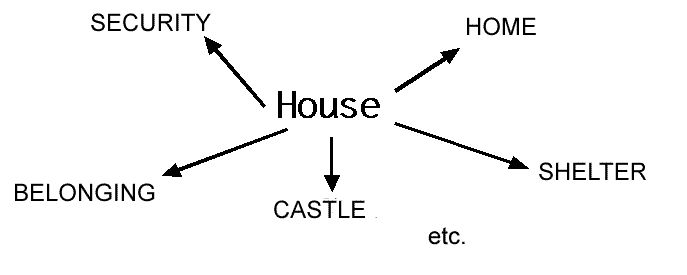
Seems okay initially - but because we are all different and have brains that are wired differently, we do not share a common set of associations for each word. (Otherwise Freud's word-association test would be pointless in psychoanalysis - like reflexes, you'd get the same responses every time!)
You could imagine people for whom the word 'Mother' conjures the memory of growing up with a loveless control freak or an alcoholic. (No 'nurturing' association there.) Likewise a house may be felt as oppressive - a confinement of walls.
* The only person who can interpret your dreams properly is yourself (you can freely interrogate your network of associations). When you try and interpret someone else's dreams you have to ask them lots of questions and make many assumptions. (The greatest assumption you make is 'normality' - i.e. "this person is a lot like me!")
Cigars - and Symbolic Overlays (!)
Your mother's appearance in a dream doesn't necessarily symbolise "comfort", "a nurturing spirit", "the symbolic return to childhood" or whatever. You could simply be thinking about mum!
How do we cope with the difficulty of deciding whether something should be considered literally - or seen as symbolic?
There is no solid rule - but I tend to think that if something in a dream seems perfectly normal and feels perfectly normal - it probably is perfectly normal!
Mood communicates a lot in dreams. If something looks alright but feels somehow wrong - it probably has a 'symbolic resonance.' [See below.] Likewise if something feels normal during the dream experience - but when thinking back on it after waking up it is realised to be quite alien in some way - it likewise has symbolic resonances. (The strangeness was hidden from us in the dream experience. There are many reasons why this can happen - a mental 'quirk' (an eccentric association between ideas we have), or, a deliberate disguising of the image by a deeper level of consciousness as an instinctive protective response!)
The symbolic and the literal can overlap in dreams. Literal events and objects can have 'symbolic resonances' overlaying them - and need to be explored in two or more dimensions simultaneously.
Approaching Your Own Dreams
By recording dreams and trying to work out what they mean you can find out the issues your unconscious mind is struggling to resolve, and gain an awareness of the processing tasks the brain is undertaking - glimpse the machine in operation.
(Despite opinions to the contrary the main function of dreams is to fine tune our strategies for dealing with serious situations in the real world. What seems like irrationality in dreams is in fact this powerful logic experimenting with alternatives, and attempting to solve complex problems by utilising whole networks of associations simultaneously.)
Now - if you awake from a dream which seems particularly interesting or significant you should record the details of the dream as quickly as you can before they are forgotten. Concentrate on the sequence of events, any words that are spoken , and any special objects, people or places. (Scribbling notes on a piece of scrap paper are fine - as long as you can read them afterwards.)
Later the information can be expanded. (Concentrating on the dream will pull a few more details out of the darkness.)
I use a variation of a model I grabbed from Nerys Dee's "Your Dreams and What They Mean." (The only popular book on dream interpretation I've encountered which isn't a load of biological wastematter!)
Entries in a Dream Diary can be set out like this:
I'll give example contents in italics.
DREAM NUMBER: 42
DATE: June 5th, 1999
TIME: 6AM, 9:30 AM, 11 PM.
ATMOSPHERE: bright sunny day; gathering storm; night
MOOD: This is how you feel. elated; anxious; fearful, etc.
THE DREAM ITSELF: In as much detail as you can muster. Expand it from your scribbled notes. The act of writing (as long as it isn't done too long after the event) will sharpen your recall.
SYMBOLS AND OTHER MOTIFS: Probably any significant object or situation in the dream which may have a symbolic interpretation - bicycle; being lost; falling; treasure; the ocean, etc. May want to think about them and try and determine which are literals, symbols, metaphors, etc.
WORDS: What characters, seen or unseen, say to you. Words that you say to others or to yourself.
NAMES: Both of characters you have dreamt of, and of real people who have appeared in your dream. The Big Scary Monster, Uncle Trevor.
PREVIOUS ASSOCIATIONS: Either draw attention to similarities between this dream and other dreams (shared symbols, etc.); and/or point out how what you have read, watched on TV or experienced has been altered by/incorporated into the dream. This activity draws out the LITERALS and can give you clues about what aspect of the REAL WORLD the dream is dealing with.
DISCUSSION: This is where you try and bring everything together to try and "nut" out what the dream may be saying to you.
It is also the hardest part of the process.
My casual advice?
1. Concentrate on the most striking or strange part of the dream, or on the aspect which gives you the strongest emotional response. (This will bring you to the heart of the dream). Ask yourself a question along the lines of "Why is this so?" eg. "Why am I so convinced there is a monster outside?" "What's that corpse doing in my living room?" "Why am I so worried about my lost luggage?"
2. Take each of the main symbols and write down what you associate with each of them - eg. as above. (This will map part of your neural net - but don't carry on the process for too long - the earliest and strongest associations are the most important.) This will help you figure out what you are dealing with.
3. Replace your variables! You can actually replace a symbol with an association in a question from process 1. This can bring you nearer to (or take you further away from) an explanation.
4. Become familiar with the language of symbols and the idea of associations. (It is a form of 'stepwise' reasoning, quite different from what we normally employ - but it is equally valid.) This is especially valuable in 'holistic reasoning' - aka 'intuition' - when we are dealing with large chunks of data simultaneously. Intuition is the single most valuable skill in dream interpretation.
How do you do this? Read Nerys' book, read stuff by Carl Jung, map out word associations, read and write poetry, read psychology books about dreams, read fairy tales, grab some of those occult-magic books for their 'tables of correspondences' and their alien philosophy of a whole worldview based on meaningful coincidences, acausal connections and self-similarities.
5. Trust your instincts - you are using the same neural network to analyse a dream as was used to generate it. It is quite natural to find the path.
6. If you fail to find the meaning in a dream do not worry too much. Any important issues which remain unresolved will be processed by other dreams.
You can have two different dreams tackling the same issue but employing different symbols. Recognising that this is happening, is like being given two simultaneous equations in mathematics. It makes it easier to solve for both of them.
7. Like anything else - the skill of dream interpretation gets better with practice.
Conclusion
The topic grows as I tackle it!
I'm aware that the last section is not entirely satisfactory. I plan
to add a third part to this essay where I will provide practical examples
of
dream analysis.
You are welcome to email me any dreams you'd like looked at! (Just provide some associations for the symbols, and any necessary background information so I don't look like a complete fool.)
*NB - Nobody sent me any dreams!
Works Consulted:
Jung, Carl G. (Editor). Man and his symbols. London : Aldus Books, 1964. [ISBN 0-904-04124-7]
The New Merriam-Webster dictionary. Springfield, Massachusetts : Merrium-Webster Inc., 1989. [ISBN 0-87779-900-8]
Dee, Nerys. Your dreams and what they mean. London : Thorsons, 1995. (First published by the Aquarian Press in 1984). [ISBN 0-7225-3218-0]
Related Works
- In This Series -
Previously: Is There Meaning in Dreams? (April 1999)
This Essay: Is There Meaning in Dreams? - An Interlude
(June 1999)
Then: Is There Meaning in Dreams (2) - Shards in
the Web, or Dig and Delve (August 1999)
See also: Invaginated Shadow Mind
Feedback and Discussions
Copyright © 1999 by Michael F. Green. All rights reserved.
Last Updated: 16 March 2003